
Wondering if lens replacement surgery could reduce your dependence on glasses or contact lenses? This consultant-led guide from Mr Manu Mathew explains who is most suitable for the procedure, from age and prescription factors to alternatives like laser eye surgery. Learn the key signs that you may benefit, who may not be suitable, and what to expect from a specialist consultation at Eagle Eye Care.

April 17, 2026
Am I a Good Candidate for Lens Replacement Surgery?

If you have been struggling with your vision and wondering whether there is a longer-term solution beyond glasses or contact lenses, lens replacement surgery may already be on your radar.
But one of the first questions most people ask is a very practical one: am I actually suitable for this?
The honest answer is that not everyone is. Lens replacement surgery, also known as refractive lens exchange (RLE) or clear lens extraction, is an excellent option for the right patient. Understanding whether that includes you is the starting point for making an informed decision.
This guide explains the key factors that determine candidacy, who tends to benefit most, and when it makes sense to consider a consultation with Mr Manu Mathew at Eagle Eye Care.
What Is Lens Replacement Surgery?
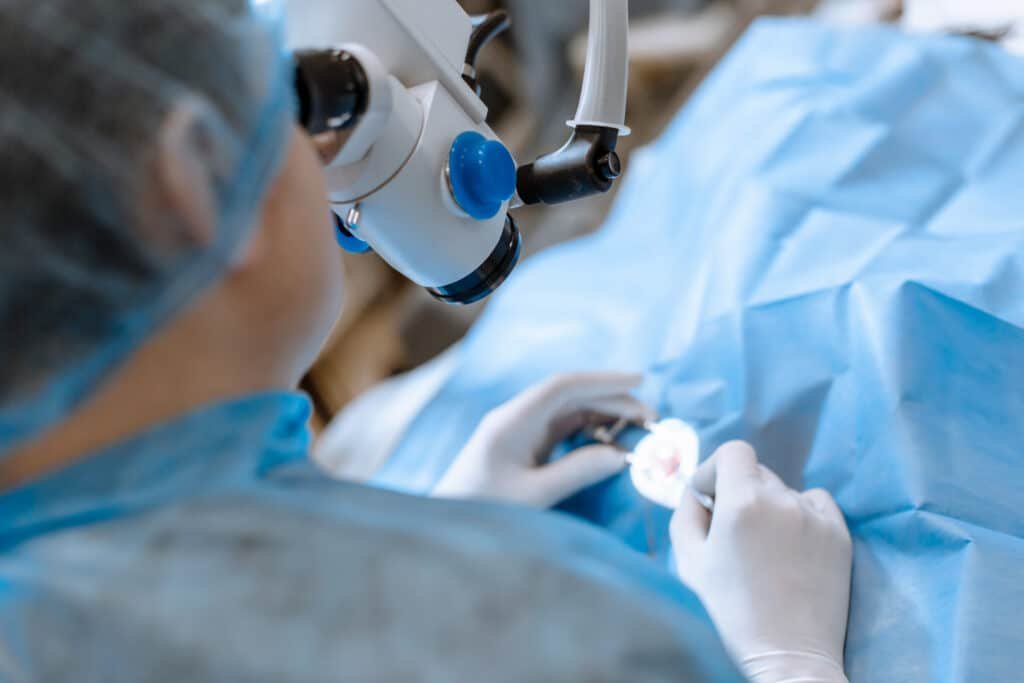
Lens replacement surgery involves removing the eye’s natural lens and replacing it with a clear artificial lens, known as an intraocular lens (IOL). The procedure uses the same technique as cataract surgery, but it is performed on a lens that may not yet be cloudy.
It can correct a wide range of refractive errors, including:
- Presbyopia (age-related loss of near focus)
- Myopia (short-sightedness)
- Hyperopia (long-sightedness)
- Astigmatism
- Early cataracts
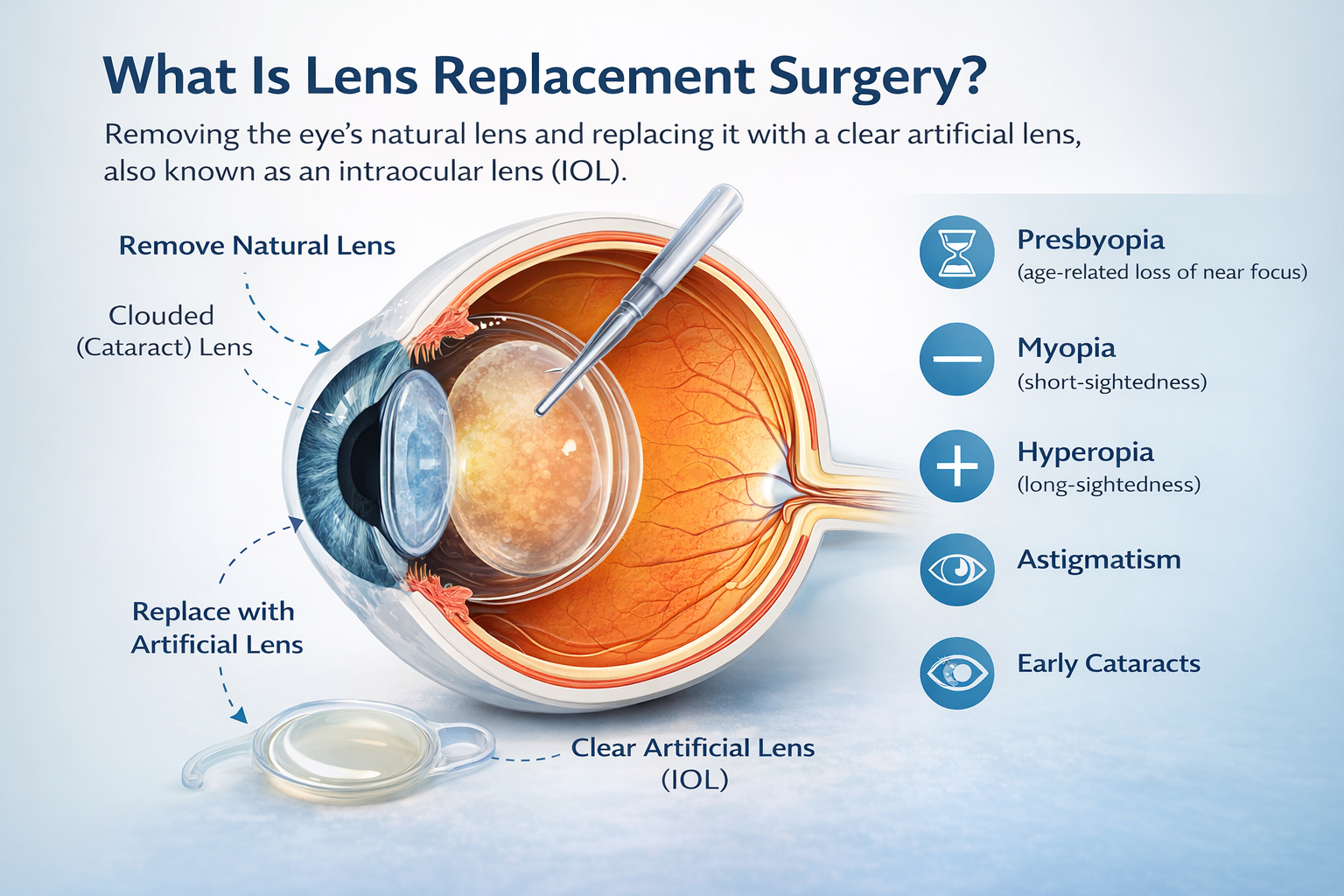
Because the natural lens is permanently replaced, the results are long-lasting. The artificial lens cannot develop a cataract, which means patients who undergo lens replacement surgery will not need cataract surgery later in life.
Who Is a Good Candidate for Lens Replacement Surgery?
There is no single profile that defines the ideal candidate. Suitability is assessed across several factors during a pre-operative consultation. That said, certain characteristics tend to make lens replacement surgery a strong option.
You Are Typically Over 40
Lens replacement surgery is most commonly recommended for patients aged 40 and over. At this stage, the natural lens is often beginning to lose its flexibility, making it harder to focus at different distances.
This age-related change, known as presbyopia, is one of the most common reasons people explore lens-based correction. If you are noticing that reading or close work has become more difficult, our guide on cataracts and normal age-related vision changes explains how to tell the difference between the two.
For younger patients, alternatives such as LASIK may be more appropriate, as their natural lens still plays an active role in focusing. Removing a flexible, functioning lens in a younger patient is generally not advisable unless there is a specific clinical reason to do so.
You Have a Significant Refractive Error
Lens replacement surgery can correct a broader range of prescriptions than laser eye surgery. It is particularly useful for patients with:
- High levels of short-sightedness or long-sightedness
- Prescriptions outside the range suitable for LASIK or LASEK
- Astigmatism that has not been adequately corrected with glasses or contact lenses
If you have a complex prescription and laser surgery has been ruled out, lens replacement is often the most effective alternative.
You Are Not Suitable for Laser Eye Surgery
Laser eye surgery reshapes the cornea to correct vision. For some patients, this is not possible. Common reasons include:
- A cornea that is too thin or irregularly shaped
- Dry eye conditions that would be worsened by laser treatment
- A prescription that falls outside the treatable range
In these situations, lens replacement surgery offers a route to reduced dependence on glasses without involving the cornea at all.
You Want to Eliminate or Reduce Dependence on Glasses
Many patients pursue lens replacement surgery not because their vision is severely impaired, but because they are tired of relying on glasses or contact lenses for everyday activities. With the right choice of IOL, it is possible to achieve good functional vision at multiple distances.
Multifocal and extended depth of focus lenses can reduce the need for both reading and distance glasses, though the outcome depends on your visual requirements and lifestyle.
You Have Early-Stage Cataracts
If you have been told you have early cataracts that are beginning to affect your daily life, lens replacement surgery is often the recommended next step. You can find out more about what to expect from the procedure on our cataract surgery page. Treating them now, before they become dense, can make the surgical process more straightforward and allow you to benefit from a premium IOL choice at the same time.
You Are in Good General Health
Like any surgical procedure, lens replacement surgery requires that you are in reasonable general health. Certain systemic conditions, such as poorly controlled diabetes, can affect healing and may influence whether you are suitable for surgery at a given point in time.
Mr Manu Mathew will assess this during the pre-operative consultation. You can read more about what the consultation involves on our lens replacement surgery service page.
Who May Not Be Suitable?
Lens replacement surgery is not appropriate for everyone. Your surgeon may advise against it if:
- You are under 40 and still have good accommodation (the ability to focus at different distances)
- You have certain retinal conditions that could increase the risk of complications
- Your eye health is otherwise compromised in a way that affects the likely outcome
- Your prescription is mild and well-managed with glasses or contact lenses
For a full overview of the potential risks involved, our blog on the risks and side effects of lens replacement surgery covers what patients should be aware of before proceeding.
Lens Replacement Surgery vs LASIK: Key Differences at a Glance
Factor | Lens Replacement Surgery | LASIK |
Age range | Typically 40+ | Usually under 45 |
Prescription range | Wide, including high scripts | Limited range |
Corneal thickness | Not a factor | Must be sufficient |
Cataract risk later | None (lens replaced) | Natural lens remains |
Permanence | Permanent | Permanent (corneal) |
Presbyopia treatment | Yes (with premium IOL) | Limited |
Signs You Should Consider a Consultation
You do not need to wait until your vision is significantly impaired to explore lens replacement surgery. Many patients come to us after noticing early signs that their vision is no longer working as well as it used to.
Consider booking a consultation if:
- Glasses or contact lenses are no longer giving you adequate vision
- You have been told laser surgery is not suitable for you
- Reading and distance vision are both becoming an issue
- You are noticing glare, halos, or reduced clarity, particularly at night
- An optician has mentioned early cataract changes
- You simply want a long-term solution that does not involve glasses
Early assessment allows for better planning and, in many cases, a wider choice of lens options.
What to Expect at a Lens Replacement Consultation
At Eagle Eye Care, all consultations are led by Mr Manu Mathew, consultant ophthalmologist. The assessment is thorough and covers:
- A full examination of your eye health
- Precise measurements of your cornea, lens and overall eye structure
- A review of your prescription history
- A discussion about your lifestyle, visual priorities and expectations
- An explanation of the IOL options available to you
You will leave the consultation with a clear understanding of whether you are a candidate, which lens type is most appropriate, and what the procedure would involve.
There is no pressure to proceed. The aim is to give you the information you need to make a confident, informed decision.
Understanding Your Lens Options
One of the most important decisions in lens replacement surgery is the type of intraocular lens used. The choice affects how well you see at different distances after surgery.
- Monofocal lenses correct vision at one distance, typically for distance. Reading glasses may still be needed.
- Multifocal lenses are designed to provide clear vision at both near and far distances, reducing dependence on glasses.
- Extended depth of focus (EDOF) lenses offer a continuous range of vision with good intermediate and distance correction.
- Toric lenses correct astigmatism and can be combined with monofocal or multifocal designs.
For more detail on the different approaches to lens-based surgery, kindly book an appointment, we are happy to sp[eak to you and give you a better understanding of your condition.
Please read our blog on the types of cataract surgery explains how the techniques compare. Mr Manu Mathew will discuss each option with
What Happens After Surgery?
Recovery from lens replacement surgery is usually straightforward. Most patients notice an improvement in vision within the first few days, with full stabilisation over the following weeks.
In some cases, a haze can develop behind the IOL months or years after surgery. This is known as posterior capsule opacification (PCO), and it is treated quickly and effectively with a simple YAG laser procedure. It is not a complication of the original surgery and does not affect the artificial lens itself.
Book and appointment to discuss further details on recovery after surgery. Mr Mathew, the surgeon, is available to respond to any queries you may have.
Why Patients Choose Eagle Eye Care
Choosing where to have lens replacement surgery is an important decision. What patients consistently value at Eagle Eye Care is clear, honest advice and continuity of care throughout the process.
- Mr Manu Mathew leads all assessments as consultant ophthalmologist
- You see the same clinician from initial consultation through to follow-up
- Treatment plans are tailored to your individual eye health and lifestyle
- There is no pressure and no hard selling
We regularly see patients from Chesterfield, Derbyshire, Sheffield, Nottingham and across the East Midlands who are looking for specialist-led private eye care.
The Bottom Line
Lens replacement surgery is not right for everyone, but for the right patient it is one of the most effective and lasting ways to reduce dependence on glasses.
The key factors are age, prescription complexity, corneal suitability for laser treatment and overall eye health. A formal assessment is the only way to determine whether you are a suitable candidate.
If you have been wondering whether lens replacement surgery might be an option for you, the most useful next step is a consultation with a specialist who can assess your eyes properly and give you an honest answer.
| At Eagle Eye Care, we provide consultant-led assessments to determine whether lens replacement surgery is the right option for you. Book a consultation or explore our frequently asked questions to find out more. There is no obligation, just clear, expert advice about your eye health and the options available to you. |
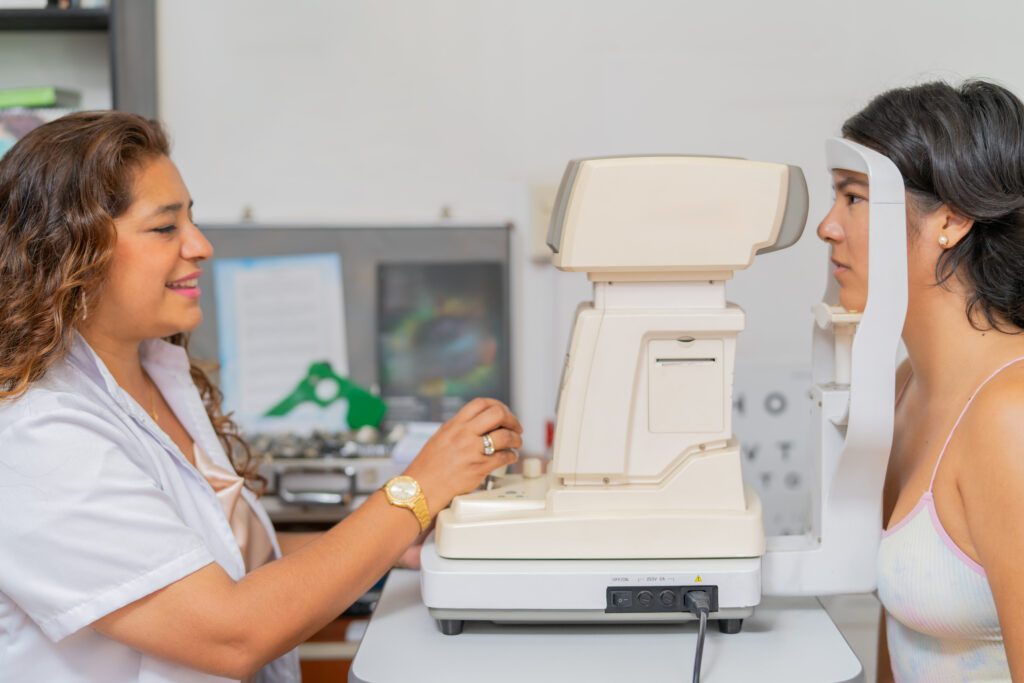
Lens replacement surgery always begins with a comprehensive assessment. Find out what is involved in our eye test in Chesterfield and take the first step towards clearer vision with Mr Manu Mathew, consultant ophthalmologist.
Frequently Asked Questions
At what age can I have lens replacement surgery?
Lens replacement surgery is typically recommended from the age of 40 onwards, when the natural lens has begun to lose flexibility. For younger patients, laser eye surgery is usually a more appropriate option.
Can lens replacement surgery fix both reading and distance vision?
With the right choice of intraocular lens, yes. Multifocal and extended depth of focus lenses are designed to reduce dependence on glasses at multiple distances. Your surgeon will advise which lens type is most suited to your prescription and lifestyle.
What if I have been told I am not suitable for LASIK?
Lens replacement surgery is often the recommended alternative for patients who cannot have laser eye surgery. Because it does not involve the cornea, conditions such as thin corneas or dry eyes do not prevent you from being a candidate.
Is lens replacement surgery the same as cataract surgery?
The surgical technique is the same. The difference is that cataract surgery removes a lens that has already become cloudy, while lens replacement surgery removes a natural lens that may still be clear, in order to correct refractive errors or prevent future cataract development.
Will I need glasses after lens replacement surgery?
This depends on the lens selected. Some patients achieve excellent functional vision without glasses at most distances. Others may still need glasses for specific tasks such as very fine print. Your surgeon will discuss realistic expectations based on your individual assessment.
Is lens replacement surgery permanent?
Yes. The artificial lens remains in place permanently. Because it cannot develop a cataract, patients who have lens replacement surgery will not require cataract surgery later in life.
How long does the procedure take?
The procedure itself typically takes 15 to 30 minutes per eye. If both eyes are being treated, surgery is usually performed on separate days.
Is it painful?
No. The procedure is performed under local anaesthetic eye drops. You will be awake but will not feel pain during the surgery. Some patients take a mild sedative to help them relax.
How long does recovery take after lens replacement surgery?
Most patients notice a meaningful improvement in vision within the first few days. Full stabilisation typically takes a few weeks, during which you will be asked to use prescribed eye drops and avoid certain activities such as swimming or rubbing the eye. Your surgeon will provide specific aftercare guidance based on your individual procedure.
Can lens replacement surgery correct astigmatism?
Yes. Toric intraocular lenses are designed specifically to correct astigmatism and can be combined with monofocal or multifocal lens designs. If astigmatism is part of your prescription, your surgeon will discuss whether a toric lens is the most appropriate option for you.
What is the difference between monofocal, multifocal and EDOF lenses?
Monofocal lenses correct vision at a single distance, usually for distance, meaning reading glasses are still likely to be needed. Multifocal lenses are designed to provide clear vision at both near and far distances. Extended depth of focus (EDOF) lenses offer a continuous range of vision with good intermediate and distance correction. Mr Manu Mathew will recommend the most suitable option based on your prescription, lifestyle and visual priorities.
What happens at the pre-operative consultation?
The consultation at Eagle Eye Care is led by Mr Manu Mathew and includes a full examination of your eye health, precise measurements of your cornea, lens and eye structure, a review of your prescription history, and a discussion about your lifestyle and expectations. You will leave with a clear understanding of whether you are a candidate and which lens option is most appropriate for you.
Can I develop a cataract after lens replacement surgery?
No. Because the natural lens is permanently removed and replaced with an artificial intraocular lens, there is no remaining tissue that can cloud over. However, some patients do experience a separate condition called posterior capsule opacification (PCO), where a haze develops behind the IOL months or years after surgery. This is not a cataract and is treated quickly and effectively with a simple YAG laser procedure.
When can I drive after lens replacement surgery?
You will not be able to drive immediately after the procedure and will need someone to take you home. Most patients can return to driving once their vision has reached the required legal standard and their surgeon has confirmed it is safe to do so, which is typically within a few days to a week. You should not drive until you have been given the go-ahead at your follow-up appointment.
Are there conditions that would make me unsuitable for lens replacement surgery?
Yes. You may not be a suitable candidate if you are under 40 with a still-flexible natural lens, if you have certain retinal conditions that could increase the risk of complications, or if your eye health is otherwise compromised in a way that could affect the outcome. Systemic conditions such as poorly controlled diabetes may also influence timing or suitability. A thorough assessment with Mr Manu Mathew is the only way to determine this with confidence.
Can lens replacement surgery be performed on both eyes?
Yes, but surgery is typically performed on each eye on separate days rather than both at the same time. This approach allows the first eye to begin recovering before the second is treated, which is considered best practice for safety and to allow for any adjustments if needed.
Selecting the appropriate surgeon for your cataract surgery is crucial in guaranteeing a favorable result. You may choose a surgeon with the necessary expertise and resources to deliver optimal care for your eyesight by conducting thorough research on credentials, carefully analyzing specializations, reviewing technological advancements, obtaining recommendations, and relying on your intuition. Remember that the objective is to have a successful surgical procedure and a great overall experience that results in enhanced eyesight and tranquility.
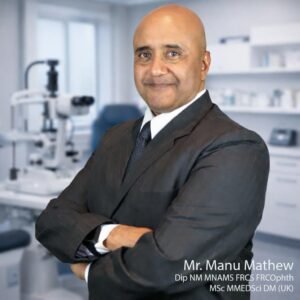
Manu Mathew is a specialist in cornea and glaucoma surgery, with a special interest in oculoplastic surgery, strabismus and medical retina.
Tags: best eye surgeon in chesterfieldcataract surgeryChesterfield eye surgeonconsultant ophthalmologist Chesterfieldcost of lens replacement surgeryeye care in chesterfieldeye conditions.eye surgeon DerbyshireLASIK alternativelens replacement cost UKlens replacement surgerypresbyopiaprivate cataract surgeryprivate ophthalmologist Chesterfieldrefractive lens exchangeRLEYAG capsulotomy