Tired of relying on glasses or contact lenses? This guide compares your correction options side by side, so you can decide whether lens replacement surgery could give you the clear, glasses-free vision you have been looking for.

May 15, 2026
Glasses or Contact Lenses vs Lens Replacement Surgery: Which Is Right for You?

If you have worn glasses or contact lenses for most of your life, you have probably wondered whether there is a better option. Perhaps your prescription keeps changing. Maybe your lenses feel uncomfortable, or you are simply tired of the daily routine. Whatever has brought you here, you are far from alone.
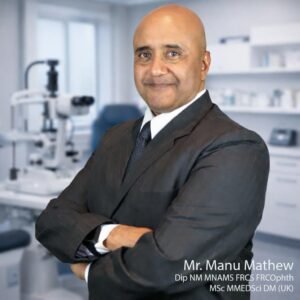
At Eagle Eye Care in Chesterfield, Mr Manu Mathew and our team help patients every day who are weighing up their options. There is no single right answer for everyone. But there is almost always a right answer for you, and this guide will help you find it.
Understanding Your Options
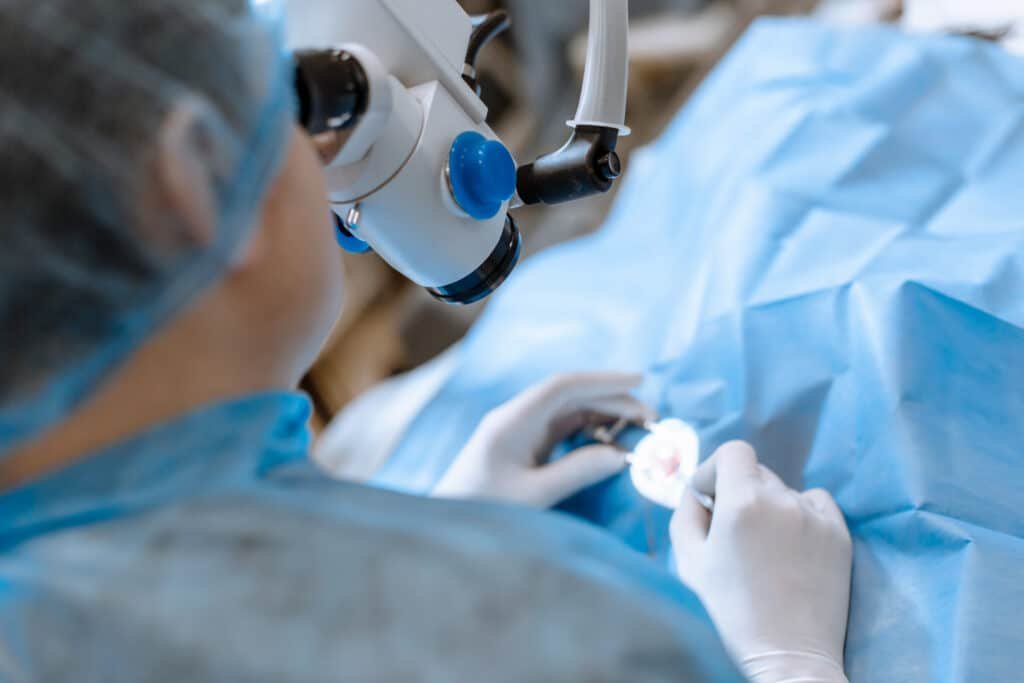
First, it helps to understand what each option actually involves. Glasses are the simplest form of vision correction. They carry no clinical risk, and you can update them as your prescription changes. Contact lenses sit directly on the surface of your eye. They suit active lifestyles and offer a wider field of view than glasses. Lens replacement surgery also known as refractive lens exchange, involves removing your natural lens and replacing it with a precisely calculated artificial lens called an intraocular lens (IOL). It uses the same technique as cataract surgery, but performed electively to correct your vision. You can read the full details on our lens replacement surgery page.Who Suits Glasses or Contact Lenses?
Corrective eyewear remains the right choice for many people. You are likely well served by glasses or contacts if:- You are under 40 with a stable prescription
- You have a mild to moderate prescription
- You prefer a non-surgical option
- Certain eye health conditions make surgery unsuitable
- You value the flexibility to update your correction easily
Who Is a Good Candidate for Lens Replacement Surgery?
Lens replacement surgery is not suitable for everyone. But for the right patient, it delivers outstanding results. We have covered this in detail in our blog on whether you are a good candidate for lens replacement surgery. Below are the key indicators.You Are Over 50
Lens replacement surgery works best for patients aged 50 and over. By this stage, your natural lens has usually lost its flexibility. As a result, laser eye surgery becomes less effective for reading vision. Replacing the lens with a premium IOL can address both distance and near vision in a way that laser simply cannot.You Have a High or Complex Prescription
If your prescription falls outside the range suitable for laser surgery, lens replacement is often your most effective surgical option. This is particularly true for patients with high myopia, high hyperopia, or significant astigmatism.You Are Developing Early Cataracts
If your natural lens is beginning to cloud, lens replacement offers a two-in-one benefit. It corrects your vision and removes the lens before it becomes a cataract. Glasses and contacts, by contrast, do nothing to address the underlying problem. You can learn more about how cataracts develop in our guide on cataracts vs ageing vision.You Want to Reduce Your Dependence on Glasses
Many patients come to us with one clear goal: to get through daily life without reaching for their glasses. With a premium multifocal or EDOF IOL, the majority of our patients achieve exactly that.How Do the Costs Compare Over Time?
Cost is one of the most common concerns patients raise. Importantly, it is worth looking at the long-term picture. Glasses and contact lenses appear affordable month to month. However, when you add up frames, lenses, coatings, contact lens subscriptions, solution, and regular eye tests over a decade, the total runs into thousands of pounds for most patients. Lens replacement surgery, by contrast, is a single upfront investment. For most patients, it eliminates or dramatically reduces their need for corrective eyewear for the rest of their life. Furthermore, patients over 50 will never need separate cataract surgery, because the procedure removes that possibility entirely. We always discuss the full cost picture honestly during your consultation at Eagle Eye Care. We want you to make a clear-eyed decision, not a rushed one.What Are the Risks of Each Option?
No form of vision correction comes without some level of risk. That includes glasses and contact lenses. Long-term contact lens wear carries a small but real risk of infections and corneal abrasions. In rare cases, poor hygiene routines lead to more serious complications. Glasses carry no clinical risk, but they do break, scratch, and get in the way. Lens replacement surgery is a surgical procedure and carries inherent risks. These include infection, inflammation, and in rare cases, retinal complications. A small number of patients also develop posterior capsule opacification (PCO) after surgery. However, this is easily treated with a quick YAG laser procedure in clinic. You can find out exactly what to expect from PCO treatment in our guide on posterior capsule opacification and YAG laser. At Eagle Eye Care, every patient receives a thorough pre-operative assessment before we make any recommendation. If surgery is not right for you, we will tell you plainly.Questions Worth Asking Yourself
There is rarely a single moment when the answer becomes obvious. However, these questions can help bring things into focus:- How much does wearing glasses or contacts affect your daily quality of life?
- Is your prescription stable, or does it keep changing?
- Are you over 50, or noticing that reading vision has become harder?
- Have you looked into laser eye surgery and been told it is not suitable?
- Are you comfortable with a surgical procedure if the outcomes are strong?
- Have you had a thorough eye examination recently?
Ready to Find Out if Lens Replacement Is Right for You?
Book your free consultation with Mr Manu Mathew at Eagle Eye Care in Chesterfield. No referral needed. No pressure. Just honest, expert advice tailored to your vision. Call us on 0800 015 0885 or visit our contact page to book online.Our Approach at Eagle Eye Care
We do not believe in a one-size-fits-all approach to vision correction. Our team takes time to understand your lifestyle, visual goals, and eye health before making any recommendation. If glasses or contacts genuinely suit you best, we will say so. If you are a strong candidate for lens replacement surgery, we will walk you through every aspect of the procedure. You can take the time you need to make an informed decision. There is no pressure, and no rush. We offer free initial consultations for patients who want to explore their options. Simply contact our Chesterfield clinic to arrange a convenient appointment.Lens replacement surgery always begins with a comprehensive assessment. Find out what is involved in our eye test in Chesterfield and take the first step towards clearer vision with Mr Manu Mathew, consultant ophthalmologist.