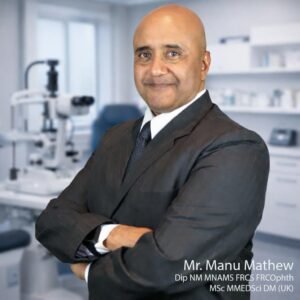

Most people notice presbyopia in their mid-forties. You hold your phone a little further away. Small print starts to blur. Reading in low light becomes harder. It is one of the most common age-related vision changes, yet many people do not realise it can be treated without glasses. Mr Manu Mathew, consultant ophthalmologist at Eagle Eye Care in Chesterfield, explains what presbyopia is, why it happens, and what your options are.

June 19, 2026
What Is Presbyopia and Can It Be Treated Without Glasses?

You hold your phone a little further away than you used to. The menu in a restaurant is harder to read. Small print that was once easy to see has started to blur.
If this sounds familiar, you are not alone. These are classic early signs of presbyopia. It affects almost everyone from their mid-forties onwards.
In this guide, Mr Manu Mathew explains what presbyopia is, why it happens, and what your treatment options are. Importantly, he also covers whether you can address it without glasses.
What Is Presbyopia?
Presbyopia is the gradual loss of the eye’s ability to focus on nearby objects. It is a natural part of ageing. Therefore, it is not a disease or a sign that something has gone wrong.
The word comes from the Greek for old eye. However, it typically begins around age 40 to 45. It progresses gradually through your fifties and tends to stabilise in your early sixties.
As a result, many people first notice presbyopia when reading becomes uncomfortable. Others notice it when switching between looking at a screen and something in the distance.
Why Does Presbyopia Happen?
To focus on close objects, the eye’s natural lens must change shape. It does this by becoming more curved. This process is called accommodation.
The lens achieves this because it is flexible. However, over time, the lens gradually stiffens. Because of this, it loses the ability to change shape effectively.
The muscles around the lens still work normally. The problem is simply that the lens itself becomes too rigid to respond. Consequently, near vision becomes blurred while distance vision often remains unaffected.
Presbyopia is different from cataracts, which involve the lens becoming cloudy rather than stiff. However, the two conditions can develop at the same time. Our guide on cataracts versus age-related vision changes explains the key differences.
What Are the Symptoms?
Presbyopia develops slowly, so many people do not realise it is happening at first. The most common symptoms include:
- Difficulty reading small text up close
- Needing to hold reading material at arm’s length
- Headaches or eye strain after close-up tasks
- Blurred vision when switching between near and far
- Needing more light to read comfortably
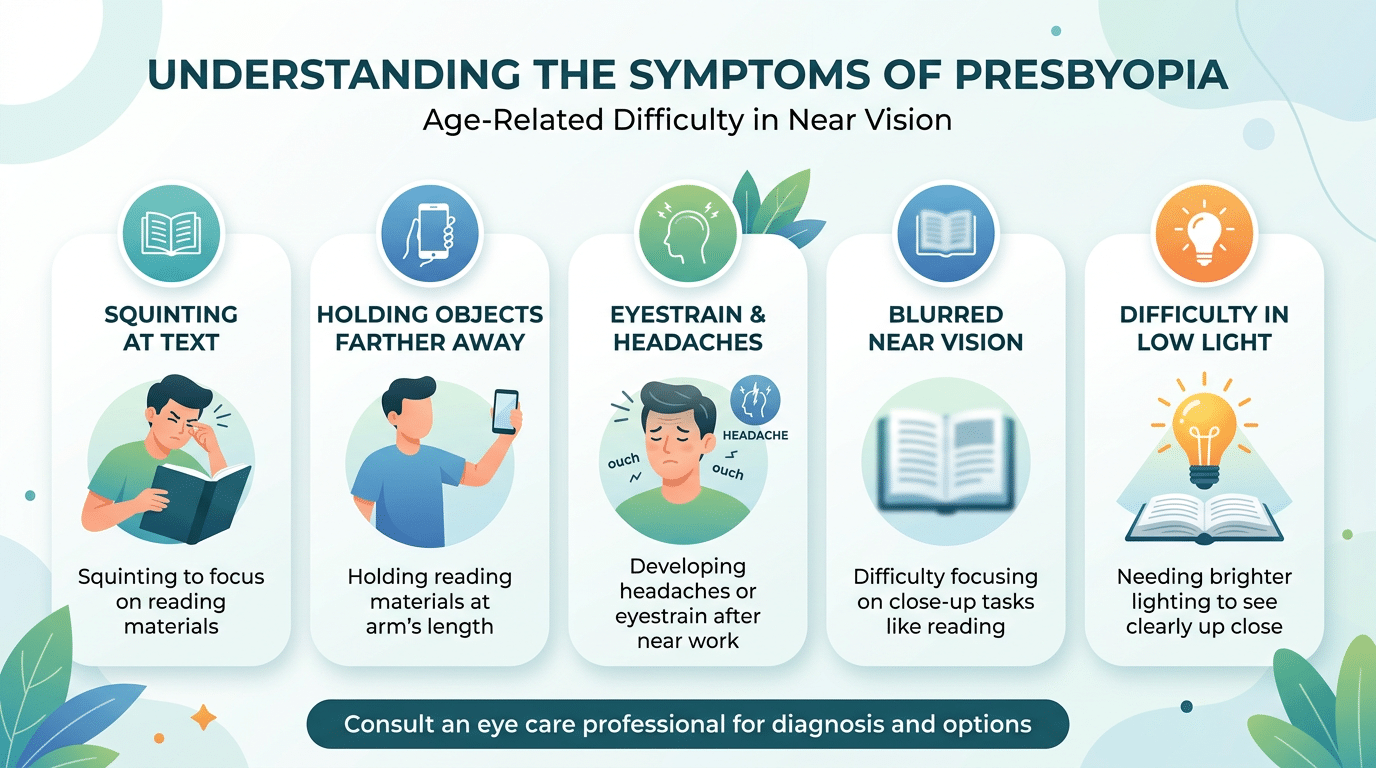
These symptoms often begin subtly. For that reason, people frequently assume they are simply tired or that their existing glasses need updating. However, if the symptoms persist, presbyopia is the most likely cause.
Is Presbyopia the Same as Long-Sightedness?
Not exactly. Long-sightedness (hyperopia) occurs when the eyeball is slightly too short. As a result, light focuses behind the retina rather than on it.
Presbyopia, on the other hand, is purely a loss of lens flexibility. You can develop presbyopia even if you have always had perfect distance vision. In addition, you can have both conditions at the same time.
Short-sighted patients are not immune either. You may find that your distance glasses no longer help you read. Alternatively, you may need to remove them to read comfortably. Both are signs that presbyopia has developed alongside your existing prescription.
Can Presbyopia Be Treated Without Glasses?
Yes, in many cases. Reading glasses are the most common solution, but they are far from the only option. Several treatments address presbyopia more permanently.
Lens Replacement Surgery
Lens replacement surgery is the most effective long-term solution for presbyopia. The procedure removes the natural lens and replaces it with an artificial intraocular lens (IOL).
Multifocal and extended depth of focus lenses are designed to correct vision at several distances. As a result, many patients achieve good functional vision for both near and far without glasses.
Because the artificial lens cannot stiffen or develop a cataract, the results are permanent. Furthermore, patients who choose this route will not need cataract surgery later in life.
Lens replacement surgery tends to suit patients over 45 with significant presbyopia. To find out if you are suitable, read our guide on who is a good candidate for lens replacement surgery.
Monovision LASIK
Monovision LASIK uses laser eye surgery to correct one eye for distance and one for near vision. The brain learns to use each eye for the appropriate task.
However, this approach suits only certain patients. Not everyone adapts well to monovision. Additionally, it does not provide the same range of vision as a premium multifocal IOL. For that reason, laser surgery is generally less suitable for presbyopia than lens replacement.
Corneal Inlays
Corneal inlays are small devices implanted into the cornea of the non-dominant eye. They improve near focus by increasing depth of field.
However, this treatment is not widely available in the UK. It is also less suitable for patients with moderate to high prescriptions. As a result, lens replacement surgery remains the most commonly recommended option for presbyopia in private eye care.
Reading Glasses and Varifocals
Reading glasses correct near vision but do not treat the underlying cause. They are a practical short-term solution. However, many patients find them inconvenient. Varifocals offer a wider range of correction but can take time to adjust to.
For patients who want a more permanent answer, lens replacement surgery is usually the most appropriate next step.
Which Lens Is Best for Presbyopia?
The right lens depends on your prescription, lifestyle, and visual priorities. There are three main options.
Multifocal Lenses
Multifocal lenses have multiple focusing zones. They allow the eye to shift between near, intermediate, and distance vision. Most patients achieve good independence from glasses. However, some notice halos or glare around lights in low-light conditions.
Extended Depth of Focus (EDOF) Lenses
EDOF lenses provide a continuous range of vision rather than distinct focal points. They tend to produce fewer visual disturbances than multifocal lenses. For that reason, they suit patients who drive at night or spend a lot of time at screens.
Monovision with Monofocal Lenses
As an alternative, monofocal lenses can be used in a monovision arrangement. One eye is corrected for distance and the other for near. This suits patients who do not adapt well to multifocal optics.
Mr Manu Mathew will discuss each option with you at your consultation. If you have questions before booking, our frequently asked questions page covers the most common queries.
What Happens If Presbyopia Is Left Untreated?
Presbyopia will not damage your eyes or cause blindness if left untreated. However, it does worsen gradually until your early sixties.
Without correction, you are likely to experience increasing eye strain, headaches, and difficulty with close tasks. Over time, this can affect your work, reading, and general quality of life.
In addition, presbyopia is closely related to the lens changes that eventually lead to cataracts. Addressing it early through lens replacement means you deal with both issues at once.
Will I Definitely Need Surgery?
No. Not everyone with presbyopia needs or wants surgery. Reading glasses and varifocals work well for many people.
Surgery tends to make the most sense when:
- Your presbyopia is affecting your daily life significantly
- You also have a refractive error that glasses do not fully correct
- You want a long-term solution that reduces dependence on glasses
- You have been told laser surgery is not suitable for your prescription
The best way to understand your options is to have a proper assessment. Read more about what to expect during a consultation at Eagle Eye Care.
Are There Any Risks to Lens Replacement Surgery for Presbyopia?
As with any surgical procedure, lens replacement surgery carries some risks. However, it is a well-established technique with a strong safety record. Our dedicated guide on the risks and side effects of lens replacement surgery covers everything you need to know before making a decision.
The most important step is a thorough pre-operative assessment. This ensures the procedure is appropriate for your specific eye health and prescription. Mr Manu Mathew will not recommend surgery unless it is genuinely the right choice for you.
Why Choose Eagle Eye Care for Presbyopia Treatment?
At Eagle Eye Care, all consultations are led by Mr Manu Mathew, consultant ophthalmologist. He brings specialist-level expertise to every assessment.
You see the same consultant throughout your care. There is no handover to a junior clinician at the point of surgery. As a result, you benefit from consistent, personalised advice at every stage.
We see patients from Chesterfield, Derbyshire, Sheffield, Nottingham and across the East Midlands. We offer a straightforward, no-pressure consultation process for anyone exploring their options
Lens replacement surgery always begins with a comprehensive assessment. Find out what is involved in our eye test in Chesterfield and take the first step towards clearer vision with Mr Manu Mathew, consultant ophthalmologist.
Frequently Asked Questions
At what age does presbyopia start?
Most people notice the first signs of presbyopia between 40 and 45. It progresses gradually and typically stabilises in the early sixties. However, the age of onset varies between individuals.
Can presbyopia be reversed?
Not in the traditional sense. The natural lens cannot regain its flexibility once it has stiffened. However, lens replacement surgery effectively bypasses the problem. It replaces the stiff natural lens with an artificial one designed to provide focus at multiple distances.
Does presbyopia affect both eyes?
Yes. Presbyopia affects both eyes, though one may be slightly more noticeable than the other at first. This is because it is caused by changes to the natural lens rather than a structural difference between the two eyes.
Is lens replacement surgery painful?
No. The procedure is carried out under local anaesthetic eye drops. You will be awake but will not feel pain. Most patients are surprised by how comfortable the process is.
Can I have both eyes treated at the same time?
Surgery is usually performed on each eye separately, a few days apart. This allows the first eye to settle before the second is treated. Your surgeon will confirm the timing during your pre-operative consultation.
Will I still need glasses after lens replacement for presbyopia?
This depends on the type of lens chosen. Many patients achieve very good vision at most distances without glasses. However, some find they still benefit from glasses for specific tasks, such as very fine print or prolonged reading. Mr Manu Mathew will set realistic expectations based on your individual assessment.
How long does the procedure take?
The procedure itself takes around 15 to 30 minutes per eye. It is carried out as a day case. Therefore, you will not need to stay overnight.
Is presbyopia the same as needing reading glasses?
Not exactly. Presbyopia is the underlying condition that causes near vision to deteriorate with age. Reading glasses correct the symptom but do not treat the cause. Presbyopia will continue to worsen over time regardless of whether you wear glasses.
Are you tired of blurred vision or seeing your loved ones suffer from the pain of improper vision? Our dedicated team is available to guide you through regaining perfect eyesight. To get started, you need to book a free consultation at Eagle Eye Care.
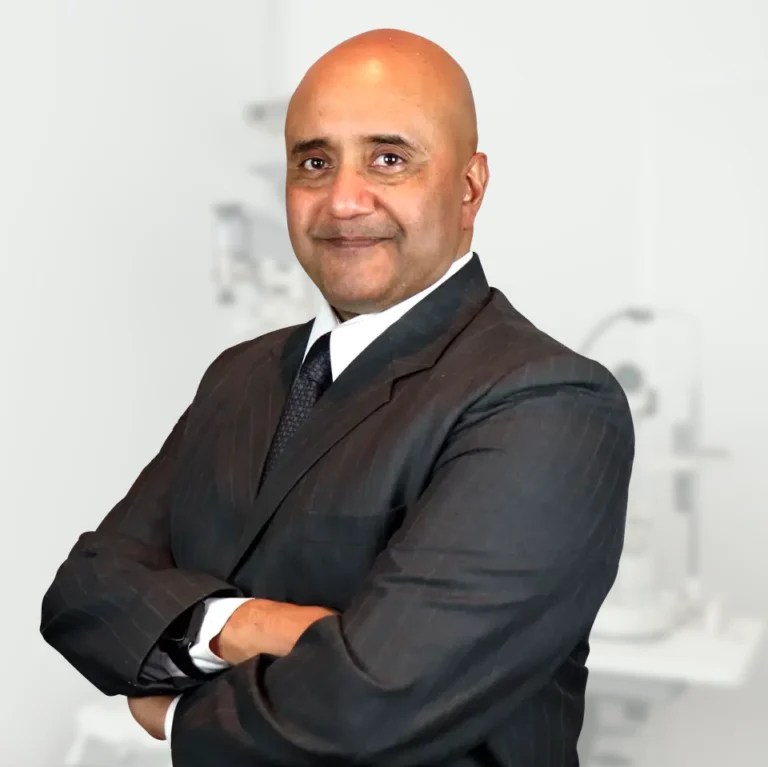
Manu Mathew is a specialist in cornea and glaucoma surgery, with a special interest in oculoplastic surgery, strabismus and medical retina.